
A hate incident is any incident which is perceived, by the victim or any other person, to be motivated by hostility, hate or prejudice. If a hate incident breaks the law, it becomes a criminal offence and therefore a hate crime.
Nottinghamshire Police records hate within any one (or more) of the following categories: race, religion, sexual orientation, disability, transgender identity, misogyny, or alternative sub -culture.
Some hate incidents are obvious, such as openly racist attacks. Others are less obvious, such as name-calling, teasing and bullying. Some are aimed at whole communities; some are targeted at individuals. Some involve words, some involve just gestures. Some involve attacks on people or attacks on buildings. The important thing is that, if it’s happening because of who you are, then it needs reporting.
You can report hate by calling 999 (for emergencies), 101 (non-emergencies), or you can report using the Notts Police website where you can also find the Live Chat widget. If you want to remain anonymous, you can report via True Vision website.
Your report can make a huge difference, even if you feel that not much can be done. That may be the case, especially when it comes to hate incidents where the law has not been broken. However, by reporting hate, you may stop it from escalating, happening again or happening to other people. Moreover, your report helps the Police and local authorities to put prevention measures in place.
After the report, you will be contacted and offered a visit, which can be refused if not wanted. Then, the hate crime risk assessment is completed to ensure you are safe. Next, you will be given an incident number with the police officer’s contact detail and offered a free support services. For crimes, an investigation will take place – if the hate element is proven, the case could go to court or result in another sanction.
Police should always discuss different outcomes and take into consideration victims wishes when its reasonable and proportionate to do so. Sometimes educating a perpetrator is better than criminalising them, especially when it comes to young people. We offer many restorative justice solutions, community resolution being one of them.
Additionally, in Nottinghamshire, we can refer individuals to two life-changing programmes called Breaking the Cycle and delivered by The National Holocaust Centre and Museum near Newark. Through learning about life for Jewish people in Nazi Germany, the programmes address the myths and stereotypes that can lead to prejudice. Minors and adults are encouraged to consider the effects of their own behaviour on others, as well as explore the impact of this behaviour on themselves.Nottinghamshire Police is dedicated to tackling hate, that’s why it employs a small Hate Crime Team to implement its Hate Crime Strategy.
The Hate Crime Strategy is based on the following four objectives:
Objective 1: Increase reporting of hate
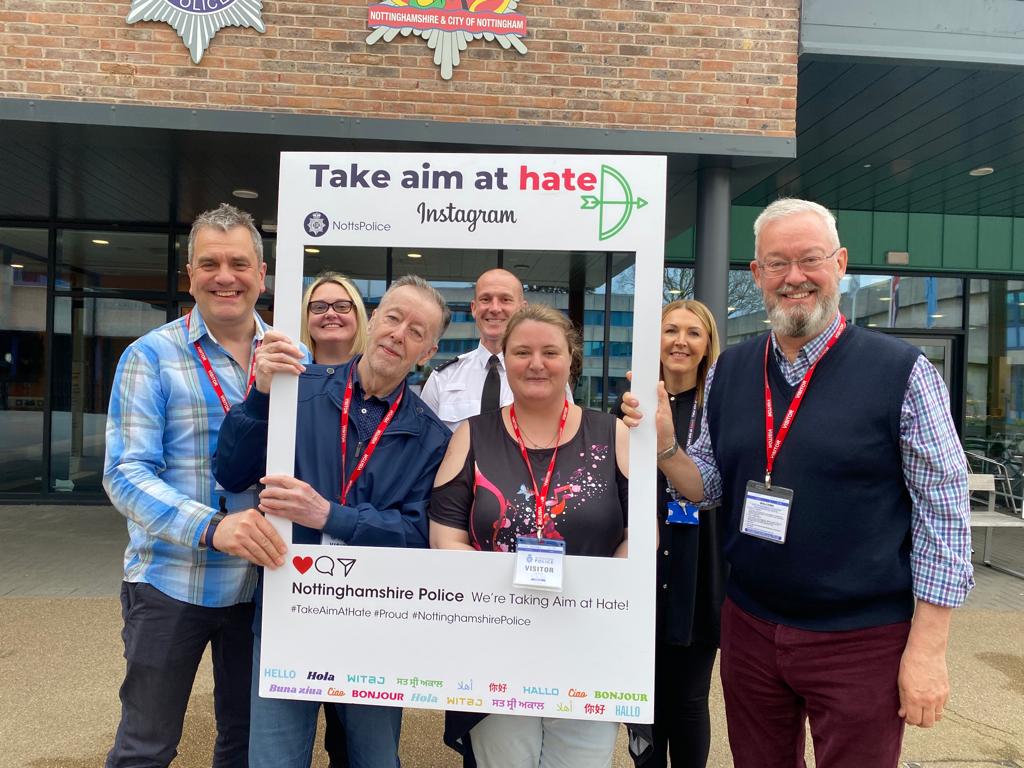
We believe that a large amount of hate goes unreported – we want you to have the trust and confidence to report hate, giving us a better understanding of what is happening to whom and where. In the longer term this will help us to focus our resources in the right places and tackle the issues. That’s why the Hate Crime Team focuses on raising awareness and explaining how you can report, the importance of reporting and what you can expect. This is encompassed in our Take Aim at Hate media campaign (have you seen photos of Nottingham Forest players with our Instagram frame on social media?) and engagement with partners (like Notts LGBT+ Network).
Objective 2: Improve victim satisfaction
We want you to have trust and confidence in policing. This will only come if you feel we deliver a good service. Hate victims can be vulnerable and from communities that already have low confidence in policing, making it even more important that they feel supported and giving them confidence that we can deliver appropriate outcomes. That’s why victims of hate receive an enhanced service. At the point of call, the control room will send the victim a link to information explaining the difference between a hate incident and a hate crime. This should help manage expectations and signpost victims to support networks. The Hate Crime Team undertake welfare calls to victims of hate, again offering support and signposting where appropriate. A victim satisfaction survey is undertaken after 3 months, and overall satisfaction is currently around 83.5%. Our aspiration is 85%.
Objective 3: Build strategic partnerships
This helps to facilitate our objectives. Partners have resources we can utilise and have access to communities we may struggle to engage with – that’s why we support other agencies and align our aims with partners. We currently work with the Universities, football clubs, Councils and other private and public sector partners.
Objective 4: Increase data quality
We believe data is key, that’s why we make sure our data quality is accurate by auditing all finalised hate occurrences. Accurate data enables us to identify and understand trends as well as identifying communities that need our support. With limited resources, accurate data helps us to better target our response.We always compare data to be able to see trends in reporting. From April 2022 to February 2023, we recorded 2259 hate occurrences, of which 367 were against sexual orientation and 83 against transgender identity. To compare: from April 2021 to February 2022, we recorded 2495 hate occurrences, of which 398 were against sexual orientation and 92 against transgender identity.
Hate crime comes in many different forms and strike at the heart of communities. With your help, we can tackle those responsible for hate crime and keep our communities safe. We’re here to help anyone who has been affected by someone else’s prejudice, ignorance, or violence.


